The Story
Half the world has no access to the internet and existing connections are increasingly slow and insecure. The need for more connectivity grows daily with more devices demanding more data but it is too expensive and too impractical to extend current infrastructure or build new networks on the ground. So the telecommunications industry is looking to the skies for a solution: sending high-speed internet down from satellites and airborne networks to the most remote and inaccessible parts of the planet.
Visuals
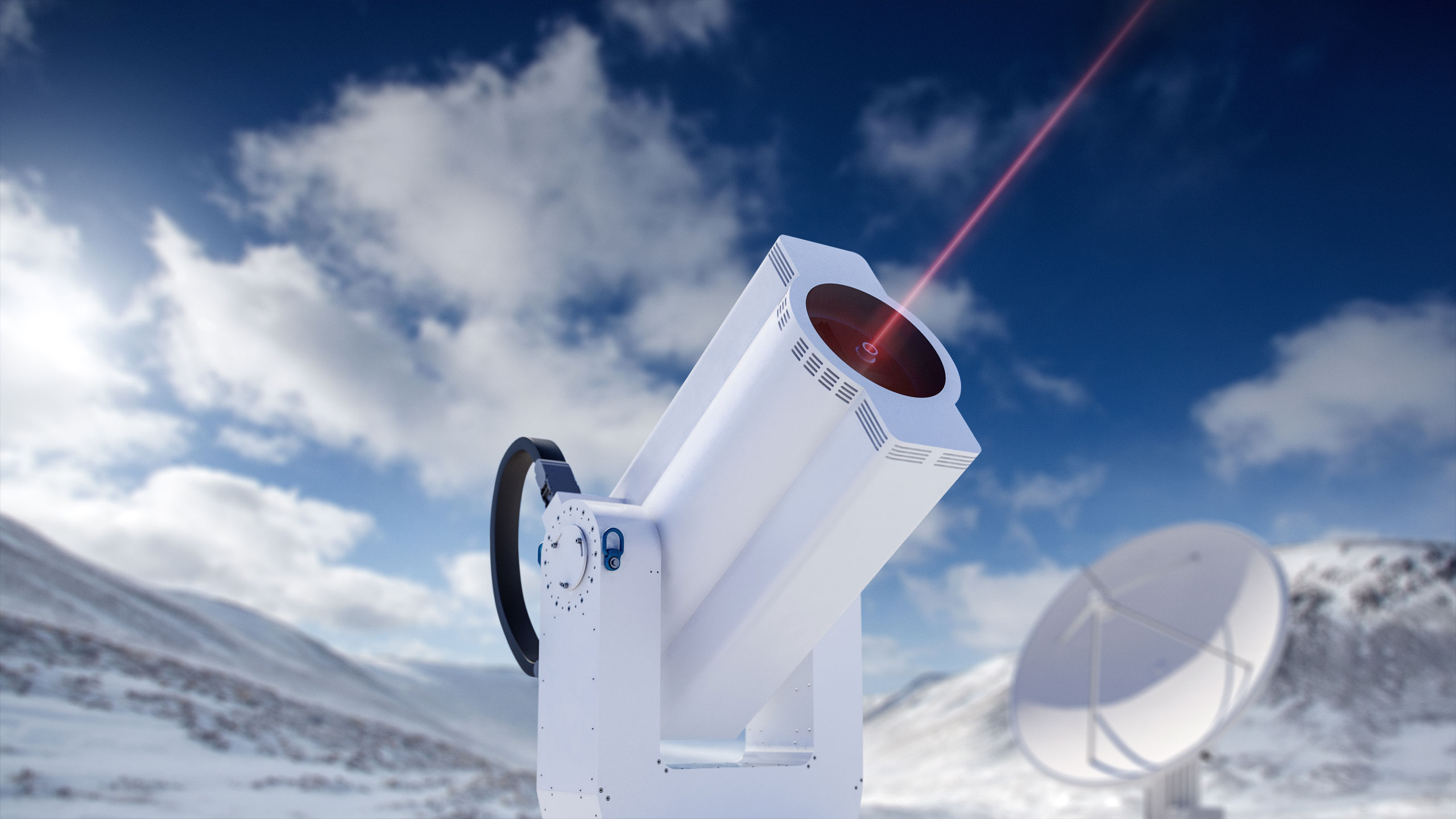


Mynaric

Mynaric is a laser communication company which develops and manufactures laser products allowing for high data rate and long-distance wireless data transmission between moving objects for terrestrial, airborne and space applications. Mynaric was founded in 2009 with the goal of commercializing wireless laser communication for aerospace applications. In 2012, Mynaric started working with customers on demonstrations of air-to-ground and air-to-air scenarios to advance technology and achieve product-level maturity. The company employs over 90 staff, acquired a total of over 45m USD growth capital and floated on the German stock market in 2017.
Background Info: The Next Internet
 Constellations are the future of internet delivery. Fibre optic cabling on the ground and across seas currently provides broadband internet but its reach is limited due to logistical and economic constraints. The exponential increase in the number of connected devices, poorly-served rural areas in the developed world – such as the mid-West of America – and remote areas in developing countries all call for a different solution. The solution being pursued by a large number of ambitious corporations around the world is to deliver broadband internet from above the clouds – via so-called ‘constellations’; networks of hundreds to thousands of aircraft, drones, balloons and satellites.

In a few years from now connectivity will be available everywhere, at all times at negligible costs. It will be as natural as the oxygen we breath be it on a ship in the middle of the Pacific, on a train through Siberia or even in space. We are nearing a time when people will no longer have to think about connectivity and devices will be built in the certainty that they are continuously connected. Imagine cargo ships autonomously crossing the oceans, access to the entire knowledge of the world from the entire world, video feeds from satellites you can view live on your smartphone, and continuous health-monitoring of the world’s population to allow for early action on disease outbreaks. In much the same way that people did not really fully grasp the potential impact of the introduction of home computers on the world, so there exists very little consideration currently of how ‘always-on’ connectivity – available the world over – will shape the future. The internet will finally reach all four corners of the globe at a cost that everybody can afford.
But the real story here is that underpinning all of these developments – providing the connectivity backbone of these constellations in the sky and space – will be laser-connected networks firing huge amounts of data across enormous distances. Without these ‘fiber optics in the sky’ the ability of the constellations to properly deliver internet to the unconnected, or to areas lacking on-the-ground infrastructure, will stutter, if not fail altogether to bring the myriad benefits of high-speed internet connection to 100% of the planet.
Whilst various journalists and numerous articles have focussed on Elon Musk and SpaceX’s Starlink constellation or Mark Zuckerberg and Facebook’s Aquila programme (still being pursued with partners even though the physical drone has been dispensed with) none have realised that what will fire all of these constellations and actually give them the technological capabilities they boast are networks in the sky mirroring those physically cabled fibre-optic networks currently in the ground.

The idea of internet beamed down from space or the upper atmosphere to places on earth where there is little or no broadband provision has been scoffed at for some time but these constellations are now beginning to be tested and satellites are beginning to be launched into space. We are at the point in time where the science fiction of these constellations has become science fact.
We feel that the story we are telling has a much wider potential reach given that activity in the market and our own technological developments are now pushing this long-predicted communication development into operational effect and, in so doing, promising to finally deliver internet access to the entire planet’s population for the first time.
Key to the development of these constellations is laser communication. It is the enabling technology that will provide the data highways – the backbone connectivity – that will guarantee ubiquitous and ‘already-on’ connectivity.
Interview Opportunity/Expert Commentary
Markus Knapek
Markus Knapek is one of the co-founders and CCO of Mynaric and is responsible for Group strategy and operations.
Between 2003 and 2011, he was employed at the German Aerospace Center (DLR), where he focused on the development of optical ground stations and atmospheric channel models in the field of laser communication.
Both Markus and Joachim are fluent English speakers and available for media interviews.

Joachim Horwath
Joachim Horwath is co-founder and CTO of Mynaric and has led product development in the field of wireless laser communication since 2009
Between 2002 and 2015 he worked for the Institute of Communications and Navigation of the German Aerospace Center (DLR) where he investigated atmospheric effects on coherent and incoherent laser communication systems and was responsible for developing a variety of aircraft laser terminals and ground stations.

Recent Mynaric Press Coverage
Recent Articles on Air-and Spaceborne Constellations
The following articles have all recently appeared regarding space- and high-altitude constellations. These are not just articles extolling the virtues of constellations but also – in the interest of fairness – those that believe they are either doomed or misguided.
Space Constellations
How SpaceX plans to bring speedy broadband to the whole world : Link
Tech giants are battling it out to supply the global internet – here’s why that’s a problem : Link
Internet heads to outer space, garbage collectors in tow : Link
FCC approves SpaceX 4425 internet satellite network : Link
The space race is over and SpaceX won : Link
The new internet from space : Link
Satellite Constellations Face Challenge : Link
Internet by Satellite Is a Space Race with No Winners : Link
How the Satellite Industry Will Change The Way We Communicate : Link
Stratosphere/High Altitude Constellations
Facebook’s Internet.org Has Connected Over 100 Million People to The Internet : Link
Report: Google is trying to buy Nokia’s airplane broadband system : Link
Aircraft Constellations
OneWeb Looks To Disrupt Inflight Connectivity Market With LEO Network : Link
Airbus, Delta, Sprint, and others join forces to make plane Wi-Fi suck less : Link
Airborne Wireless Network Applies to Test Infinitus : Link
Constellations: Where and How They Operate
Airplane constellations are laser-linked networks of airplanes which provide lightning fast in-flight WiFi connectivity and real-time access to maintenance data from the ground to improve predictive aircraft management for cockpit and ground maintenance teams.
High-altitude networks utilize high-altitude platforms such as balloons or unmanned aerial vehicles (UAVs) and interconnects them using high-speed laser communication links. These are then linked to the existing terrestrial network through high-speed air-to-ground connections.
Constellations in space are networks of hundreds – actually it will be thousands – of satellites all linked by laser communication. The distance between each satellite can be up to 4,500 km allowing for a network that can bridge distances circling the entire planet.
Earth Observation missions from space monitor numerous activities back on the ground. But vital information concerning agriculture, the environment, shipping routes and a whole range of other areas is currently lost as limitations in existing communication mean only 70% of information makes it back to Earth for interpretation. Laser communication would solve this bottle-neck and allow for all information collected to be transmitted back to the ground.
